
Research Interest
- Brief Introduction
- Phase Engineering of Nanomaterials (PEN)
- Epitaxial Growth of Hybrid Nanostructures
- Synthesis of Ultrathin 2D Nanomaterials
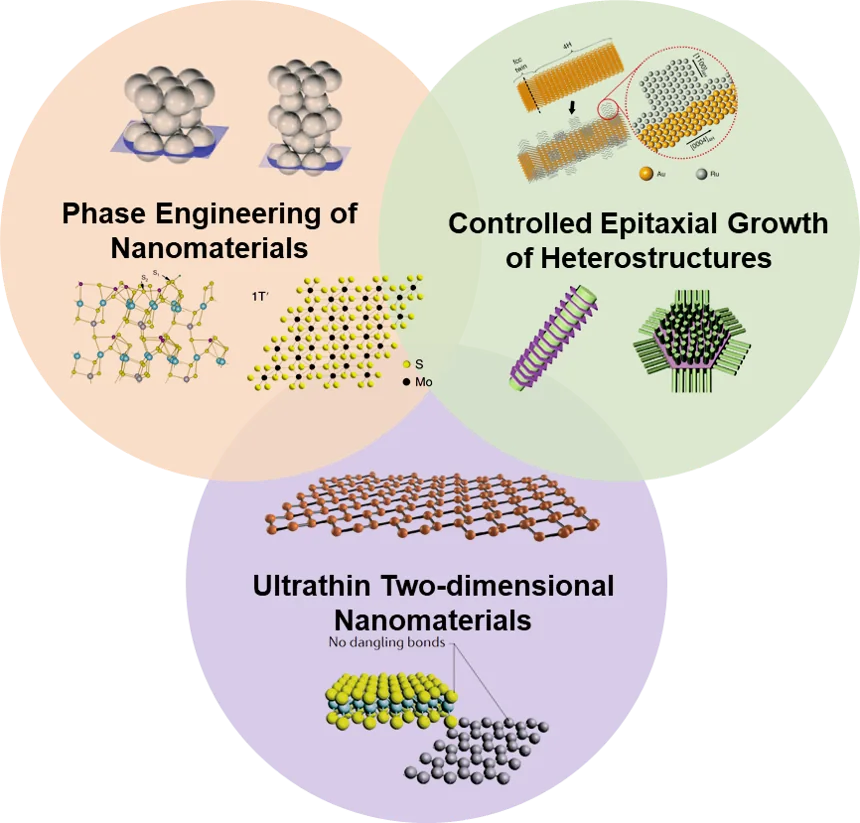
Brief Introduction
Dr. Zhang’s research is highly interdisciplinary. His current research interests focus on the (crystal-)phase engineering of nanomaterials and controlled epitaxial growth of heterostructures, including the synthesis of ultrathin two-dimensional nanomaterials (e.g. metal nanosheets, graphene, metal dichalcogenides, metal-organic frameworks, covalent organic frameworks, etc.), novel metallic and semiconducting nanomaterials, novel amorphous nanomaterials and their hybrid composites, for various applications such as catalysis, clean energy, (opto-)electronic devices, nano- and biosensors, and water remediation.
1. Phase Engineering of Nanomaterials (PEN)
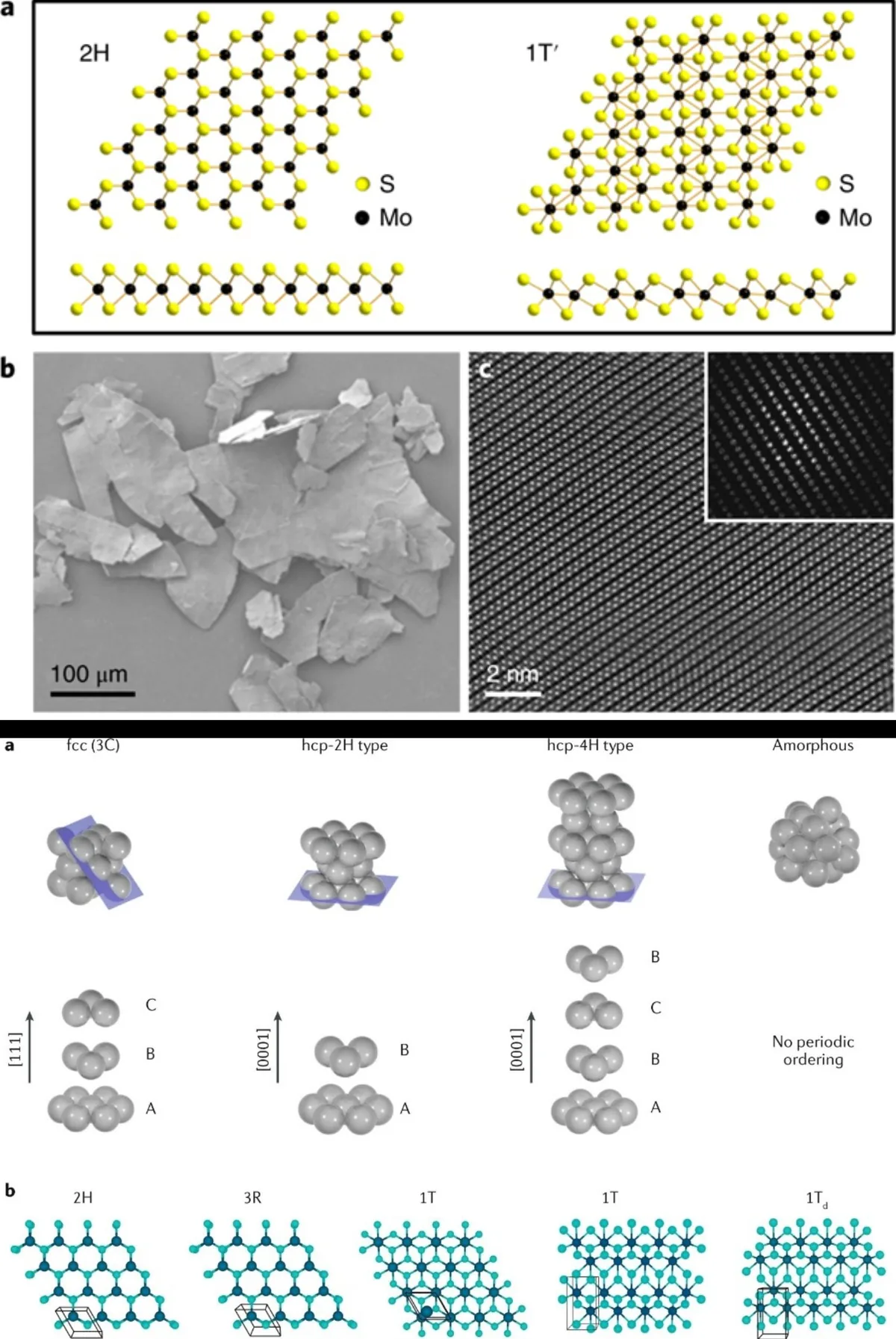
Phase has emerged as an important structural parameter — in addition to composition, morphology, architecture, facet, size and dimensionality — that determines the properties and functionalities of nanomaterials. In particular, unconventional phases in nanomaterials that are unattainable in the bulk state can potentially endow nanomaterials with intriguing properties and innovative applications. Our group has made great progress in the phase engineering of nanomaterials (PEN), including synthesis of nanomaterials with unconventional phases and phase transformation of nanomaterials, with a focus on noble metals and layered transition metal dichalcogenides. Besides, we have successfully prepared a series of amorphous nanomaterials, amorphous–crystalline and crystal phase-based hetero-nanostructures. Despite these, huge work remains to be done in this emerging field, including exploration of phase-dependent properties and applications, rational design of phase-based heterostructures and extension of the concept of phase engineering to a wider range of materials.
References
(1) Y. Chen, Z. Lai, X. Zhang et al.: "Phase engineering of nanomaterials", Nat. Rev. Chem., 2020, 4, 243-256. Link
(2) Y. Yu, G. Nam, Q. He et al.: "High phase-purity 1T′-MoS2- and 1T′-MoSe2-layered crystals", Nat. Chem., 2018, 10, 638-643. Link
(3) X. Zhang, Z. Luo, P. Yu et al.: "Lithiation-induced amorphization of Pd3P2S8 for highly efficient hydrogen evolution", Nat. Catal., 2018, 1, 460-468. Link
2. Epitaxial Growth of Hybrid Nanostructures
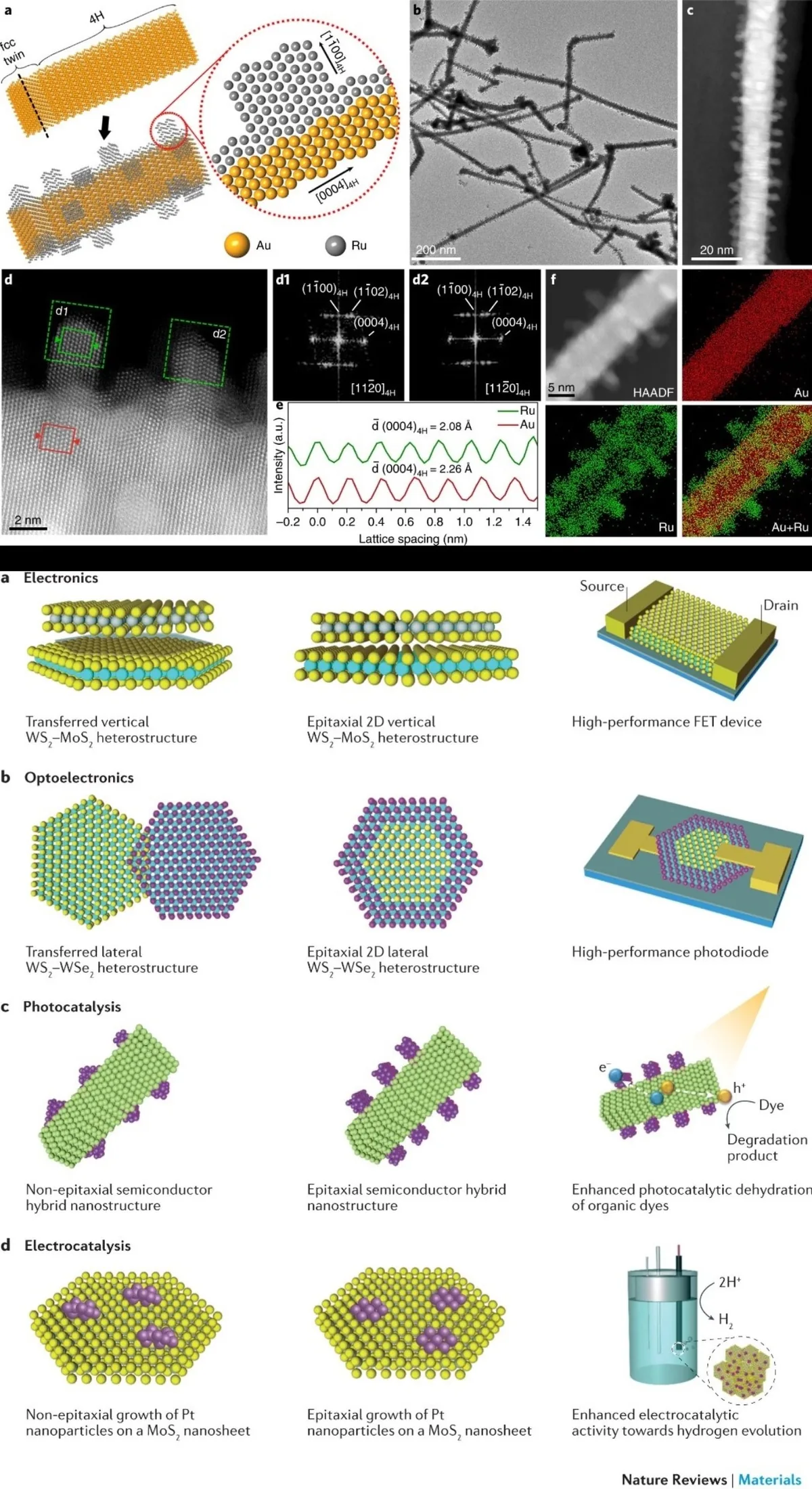
Hybrid nanostructures are a class of materials that are typically composed of two or more different components, in which each component has at least one dimension on the nanoscale. The rational design and controlled synthesis of hybrid nanostructures are of great importance in enabling the fine tuning of their properties and functions. Epitaxial growth is a promising approach to the controlled synthesis of hybrid nanostructures with desired structures, crystal phases, exposed facets and/or interfaces. In particular, the novel-phase nanomaterials have brought new vitality to the traditional epitaxial growth. Besides, the preparation of well-defined multilevel structure via controlled epitaxial growth is still challenging.
References
(1) C. Tan, J. Chen, X. Wu et al.: "Epitaxial growth of hybrid nanostructures", Nat. Rev. Mater., 2018, 3, 17089. Link
(2) Q. Lu, A. Wang, Y. Gong et al.: "Crystal phase-based epitaxial growth of hybrid noble metal nanostructures on 4H/fcc Au nanowires", Nat. Chem., 2018, 10, 456-461. Link
3. Synthesis of Ultrathin 2D Nanomaterials
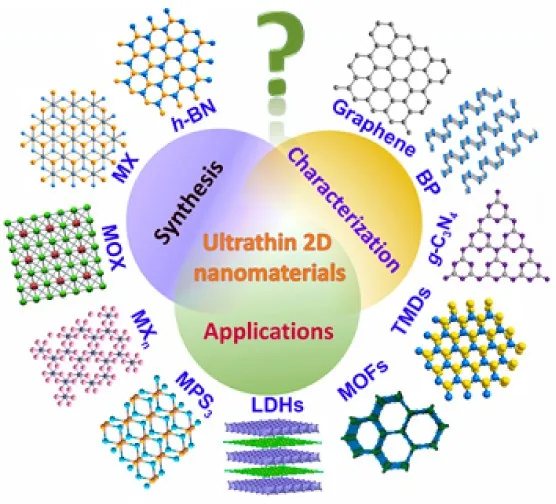
Since the discovery of mechanically exfoliated graphene in 2004, research on ultrathin two-dimensional (2D) nanomaterials has grown exponentially in the fields of condensed matter physics, material science, chemistry, and nanotechnology. Ultrathin 2D nanomaterials have compelling physical, chemical, electronic, and optical properties, as well as potential applications in electronics/optoelectronics, electrocatalysis, batteries, supercapacitors, solar cells, photocatalysis, and sensing platforms. In recent years, ultrathin 2D nanomaterials have become a superexcellent platform for low dimensional physics, resulting in rich breakthroughs. The preparation of ultrathin 2D nanosheets based on non-layer structured materials is an important direction in the future.
References
(1) C. Tan, X. Cao et al.: "Recent Advances in Ultrathin Two-Dimensional Nanomaterials", Chem. Rev., 2017, 117, 9, 6225-6331. Link